
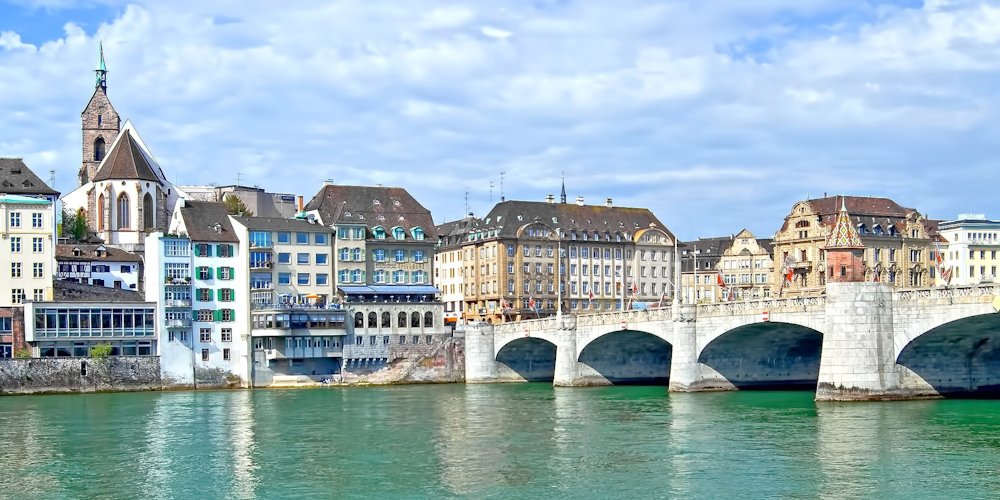
We are excited to announce that the next CCG European UGM & Conference will be held from May 19 to 22 in Basel, Switzerland. This 4-day event will feature workshops, scientific presentations, a poster session, and social activities, including receptions and a conference dinner.
If you would be interested in presenting at the meeting, please contact Steve Maginn at .
Registration Opens (Check-in/Badge pick-up)
Peptide Modeling, Conformational Searching and Docking
Structure preparation / Non-natural amino acids / Protein Design / Conformational searching / Distance restraints / Peptide-Protein docking / Protein-Ligand Interaction Fingerprints (PLIFs)
Structure preparation / Non-natural amino acids / Protein Design / Conformational searching / Distance restraints / Peptide-Protein docking / Protein-Ligand Interaction Fingerprints (PLIFs)
Cheminformatics: Manage, Analyze, Model and Mine Molecular Data
MOE databases / Molecular descriptors / Database filters / Sorting and coloring / Plots / Clustering / Diverse subset selection / QSAR modeling / Binary QSAR / Substructure searching / Molecular fingerprints / Similarity searching
MOE databases / Molecular descriptors / Database filters / Sorting and coloring / Plots / Clustering / Diverse subset selection / QSAR modeling / Binary QSAR / Substructure searching / Molecular fingerprints / Similarity searching
Welcome Refreshments
Antibody Modeling and Protein Engineering
Protein Engineering / Protein Properties / Protein Contacts / Developability / Molecular surfaces / Hot spot analysis / Antibody modeling
Protein Engineering / Protein Properties / Protein Contacts / Developability / Molecular surfaces / Hot spot analysis / Antibody modeling
Ligand-based Drug Design and Interactive SAR and MMP Analysis
MOEsaic / Matched Molecular Pairs / R-group analysis / Similarity and substructure searching / Multi-parameter optimization / Free-Wilson analysis / Molecular alignments / Pharmacophores
MOEsaic / Matched Molecular Pairs / R-group analysis / Similarity and substructure searching / Multi-parameter optimization / Free-Wilson analysis / Molecular alignments / Pharmacophores
Lunch Break
Biologics: Protein Alignments, Modeling and Docking
Alignments and superposition / Loop and linker modeling / Protein-Protein docking / Protein-Ligand Interaction Fingerprints (PLIFs) / Epitope analysis / Homology modeling / Solubility analysis / QSAR modeling / 2D hot spot mapping
Alignments and superposition / Loop and linker modeling / Protein-Protein docking / Protein-Ligand Interaction Fingerprints (PLIFs) / Epitope analysis / Homology modeling / Solubility analysis / QSAR modeling / 2D hot spot mapping
SBDD: Generating and Prioritizing Novel Design Ideas using Docking and Fragments-based Optimization
Protein-ligand interactions / Protein-ligand docking / Pharmacophore modeling / Template-based docking / Scaffold replacement / R-group exploration / Bioisosteric transformations / Ligand properties / PLIFs
Protein-ligand interactions / Protein-ligand docking / Pharmacophore modeling / Template-based docking / Scaffold replacement / R-group exploration / Bioisosteric transformations / Ligand properties / PLIFs
Opening Reception & Poster Session
Group Activity: Walking Tour
Welcome Refreshments
Opening Remarks
Designing Surface-centric Binders for Targeting PPI-relevant Sites on the Human Surfaceome
Che Yang, Specialist Modelling Scientist, Peptide & Protein Design,Novo Nordisk
Che Yang, Specialist Modelling Scientist, Peptide & Protein Design,
In Silico Risk Assessment for Rational Design of Variants: Humanization and Developability Improvement Use Cases
José Pereira, Head of Bioinformatics,FairJourney Biologics
José Pereira, Head of Bioinformatics,
Modulating mAbs Function through Glycosylation and Isotype: A Molecular Dynamics Perspective
Ivano Eberini, Associate Professor of Biochemistry,University of Milan
Ivano Eberini, Associate Professor of Biochemistry,
Morning Break
Modeling Colloidal Stability of Complex Molecules
Alexander Kötter, Computational Scientist, Large Molecule Research,Sanofi
Alexander Kötter, Computational Scientist, Large Molecule Research,
Optimizing Colloidal Stability and Viscosity of Multispecific Antibodies at the Drug Discovery-development Interface
Giuseppe Licari, Principal Scientist,Merck KGaA
Giuseppe Licari, Principal Scientist,
Accelerating Biopharmaceutical Formulation Development with Excipient Prediction Software (ExPreSo)
Mark Teese, Product Owner, Bioinformatics,Leukocare AG
Mark Teese, Product Owner, Bioinformatics,
Lunch Break
Lipid Multi-Scale Engineering Approach: AI Design, Screening, and Assembling
Anastasia Markina, Scientist, Chem- and Bioinformatics,BioNTech SE
Anastasia Markina, Scientist, Chem- and Bioinformatics,
PANTHER Score: Protein-Affinity for Nucleic Target-binding, Hybridization, and Energy Regression
Akash Deep Biswas, Senior Scientist,Dompé farmaceutici S.p.A
Akash Deep Biswas, Senior Scientist,
Efficient Conformational Sampling in Nucleic Acids Using LowModeMD
Philippe Archambault, Applications Scientist,Chemical Computing Group
Philippe Archambault, Applications Scientist,
Afternoon Break
Drugging the Undruggable: Modeling Strategies for the Discovery of a First-in-Class Inhibitor of tRNA-Modifying Enzymes
Daniele Parisi, Senior Computational Drug Discovery Scientist,THERAtRAME SA
Daniele Parisi, Senior Computational Drug Discovery Scientist,
Ring Systems in Medicinal Chemistry - Where the Bioactivity is Hidden
Peter Ertl, Director, Cheminformatics,Ertl Molecular
Peter Ertl, Director, Cheminformatics,
Drinks Reception and Conference Dinner at Museum Kleines Klingental
Welcome Refreshments
Application of Ultra Large Chemical Spaces
Jan Skácel, Director, Head of Medicinal Chemistry,PharmTheon
Jan Skácel, Director, Head of Medicinal Chemistry,
Practical Considerations for In Silico Identification of Cryptic Binding Sites
Michael Bodnarchuk, Principal Scientist,AstraZeneca
Michael Bodnarchuk, Principal Scientist,
Morning Break
Discovery and Optimization of First-in-Class Inhibitors of the JUNO
IZUMO1 Interaction for Non-Hormonal Contraception
David Schaller, Scientist, Computational Drug Design,Nuvisan
David Schaller, Scientist, Computational Drug Design,
Can Molecular Dynamics Serve as a Post-Docking Pose Filter?
Thomas Steinbrecher, Principal Scientist,Roche
Thomas Steinbrecher, Principal Scientist,
A Novel Tool for Accelerating SAR Reporting and Analysis, to Enhance Compound Design
Aurélie Mallinger, Laboratory Leader,Bayer CropScience
Aurélie Mallinger, Laboratory Leader,
Lunch Break
Adventures in Aspartate: Covalent Targeting of KRASG12D
Andrea Vaupel, Senior Principal Scientist, Global Discovery Chemistry,Novartis
Andrea Vaupel, Senior Principal Scientist, Global Discovery Chemistry,
Real-World Covalent Drug Discovery: Cysteine and Beyond
Rainer Wilcken, Senior Director, Drug Maker, Computational Chemistry,Curie.Bio
Rainer Wilcken, Senior Director, Drug Maker, Computational Chemistry,
In-silico Guided Design and Optimization of Small Molecule IL-17 Inhibitors
Matthias Bauer, AD & Senior Data Scientist,Novartis
Matthias Bauer, AD & Senior Data Scientist,
Closing Remarks
Closing Reception